
Local SEO keyword research is the process of finding the search terms people in a specific service area use when they are ready to hire a business like yours. It differs from general keyword research in two ways: the queries carry geographic modifiers or implied location, and the volume and difficulty numbers most tools report are measured nationally, which makes them unreliable for judging a single market. The method that works locally is modifier-driven discovery, intent ranking by cost-per-click, and validation against the actual local results page rather than a difficulty score.
What are the four types of local keyword modifiers?
Local queries fall into four buckets: service-plus-city, near-me, neighborhood, and problem-phrasing with local intent. Build your seed list by running every core service through all four.
| Modifier type | Example | What it signals |
|---|---|---|
| Service + city | "drain cleaning tulsa" | Comparison shopping; the searcher will look at several providers |
| Near-me | "emergency plumber near me" | Urgency; proximity matters more than reputation |
| Neighborhood or landmark | "hvac repair midtown" | A resident, not a visitor |
| Problem-phrasing | "water heater leaking from bottom" | Early-stage, but Google often localizes it anyway |
The fourth bucket is the one most businesses miss. Nobody types a city into "water heater leaking from bottom", yet Google frequently answers it with nearby plumbers. For the general mechanics, read what SEO keywords are; this post covers only what changes when geography enters.
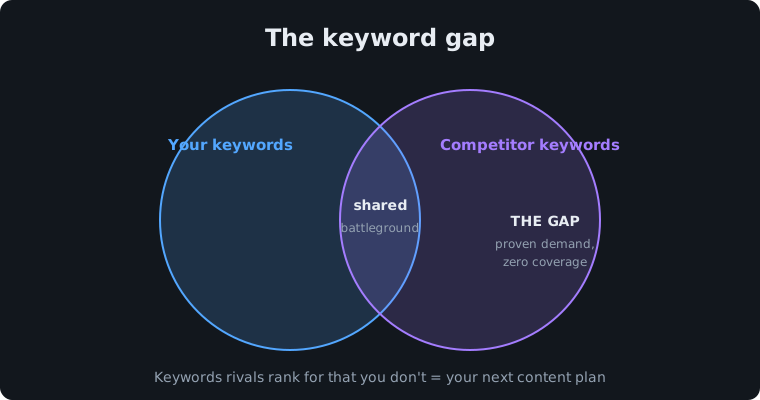
A fast way to fill the buckets is competitor keyword research: pull the terms local rivals rank for that you do not, then sort them into the taxonomy. That gap — the highlighted slice in the diagram above — is where the cheapest wins usually sit.
Why does search volume data mislead for local keywords?
Because most local SEO tools report volume at the national or metro level, not for your service area. A term showing 20 searches a month can be a lead machine in one city, and a term showing thousands can be worthless because almost none of those searches happen where you operate.
Volume is an aggregate with no geography attached. The reported number for "plumber near me" counts the whole country, not your drive radius. Low-volume local terms get culled at exactly the moment they deserve attention: when every one of those few searchers is a nearby prospect.
The practical rule: use volume only to compare terms within your own list, never as an absolute go or no-go. If a term describes a service you sell plus a place you serve, it stays on the list even at zero reported volume.
How do you find implicit-local keywords?
Check the search results page: if Google shows a map pack for a query with no place name in it, Google has decided that query is local. That is the entire test.
Terms like "emergency dentist" or "who fixes garage doors" get localized automatically. Search each candidate from your list and note which ones trigger a map pack. Those queries are answered with nearby businesses, and your Google Business profile is what competes in that pack — so implicit-local terms belong in your plan twice, once for organic pages and once for the profile.
Also open Search Console and read your existing queries. Implicit-local terms you already earn impressions for are validated demand, not guesses.
How should you rank local keywords by value?
Sort by cost-per-click, not volume. CPC is what advertisers actually pay for one click, which makes it the most honest public signal of what a searcher is worth.
Take this post's own target term. "Local SEO keyword research" shows 210 monthly searches — small — with a difficulty of 24 and a $22.07 CPC. Advertisers pay twenty-two dollars for a single click because the person searching is likely evaluating a paid service. A 210-volume term with that CPC outearns a high-volume informational term with negligible CPC. The same arithmetic holds for a plumber or roofer: the modifiers carrying real CPCs mark the revenue terms. Where a term shows no CPC at all, treat it as informational and schedule it behind the commercial terms.
Should you trust keyword difficulty scores for local terms?
No. Validate against the actual local SERP instead, because difficulty scores are typically computed from national-level link data and say little about who you must outrank in one city.
- Set your rank tracker or browser location to the target city and search the term.
- Note whether a map pack appears and which businesses are in it.
- Read organic page one: local businesses, national directories, or pages ranking incidentally?
- Open the top local pages and judge whether they genuinely target the term.
If page one is directories and incidental pages, the term is winnable regardless of what the difficulty column says. Scissortail Fractional, a brand-new domain ImpressionMine launched, reached the top ten for 11 of 11 target keywords within eight days, six at position one, with zero ad spend. We will not claim which technique caused that. The point is narrower: the difficulty scores never got a vote. The local SERP did.
WRITTEN BY
ImpressionMine Team
SEO Research
Ready to mine your competitive edge?
Get MiningMORE FROM THE BLOG


