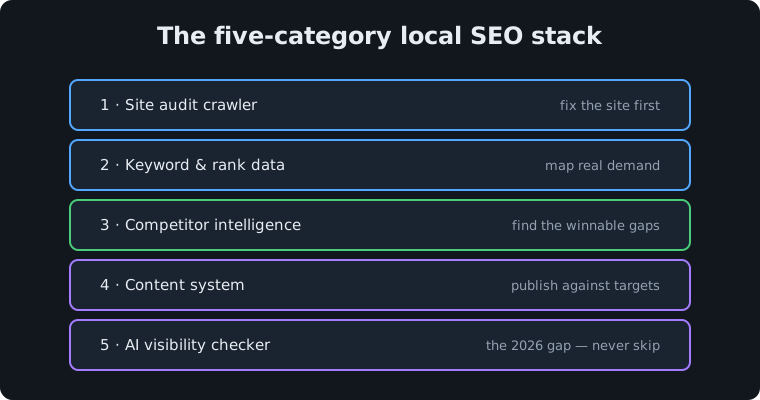
Local SEO tools fall into five categories — audit crawlers, keyword and rank data, competitor intelligence, content systems, and AI visibility checkers — and most local businesses need one good option per category, not the fifteen-tool stack the industry sells. ImpressionMine's September 2026 keyword probe measured "local seo tools" at keyword difficulty 22 with a $20 cost-per-click, sitting in a cluster with "local seo software" and "best seo tools" — evidence that plenty of owners are shopping for tooling and mostly finding listicles written by the tools themselves. Here is the honest version of what each category does, and when you can skip it.
What are the five categories of local SEO tools?
Every local SEO tool on the market does one of five jobs. Judge any subscription by which job it does and whether that job is currently your bottleneck:
| Category | What it does | Skip it if |
|---|---|---|
| Site audit crawler | Crawls your pages, flags technical and on-page issues, scores health | You've audited in the last year and fixed the list |
| Keyword & rank data | Search volumes, difficulty, your positions over time | You haven't yet fixed the technical issues — data can't help a broken site |
| Competitor intelligence | What rivals rank for, gap analysis, SERP strength | You're the only provider in your market (rare) |
| Content system | Plans, drafts, and publishes pages against keyword targets | You have no keyword map yet — content without targeting is noise |
| AI visibility checker | Tests crawler access, structure, citability for AI engines | Never skip this in 2026 — it's the newest gap and the cheapest to close |
Do you need an all-in-one platform or separate tools?
Separate tools win on depth; a platform wins on the connections between the jobs. The expensive failure mode isn't picking the wrong crawler — it's owning five subscriptions whose outputs never meet: the audit says fix titles, the keyword tool lists volumes, and nobody turns either into a publishing plan. If you assemble your own stack, budget $150–$400 per month across categories and expect to be the integration layer yourself. The alternative is buying the integrated read once: ImpressionMine's strategic report runs the audit, keyword mapping, competitor gap analysis, and AI visibility check as one pipeline and delivers the combined plan, priced as a one-time report or a done-for-you build.
What should a local SEO audit tool actually check?
A local audit tool should crawl every page and score four things: technical health (broken links, redirects, indexability), on-page quality (titles, headings, internal links), local signals (name-address-phone consistency, local schema), and — the 2026 addition — machine legibility for AI crawlers. The full checklist is in our breakdown of what SEO audit services include. One warning from the field: tools that re-scan weekly mostly re-find the same issues; the value is in fixing the list, not watching it.
Which tools matter for AI search visibility?
The AI visibility category is where tooling is thinnest and the gap is widest — most checkers verify only whether GPTBot, ClaudeBot, PerplexityBot, and Google-Extended can reach your site, but access is just the first of four layers (structure, citability, and authority are the others). Our guide to AI SEO services walks the full stack, including the llms.txt file and schema.org structured data most small-business sites are still missing. Given that this is the youngest category, prefer providers that show you a scored breakdown over ones that print a single pass/fail.
How do you choose without wasting a year of subscriptions?
Sequence by bottleneck, and buy data before dashboards. The order that works for local businesses: audit once and fix the list; map keywords against real demand, using competitor keyword research to find the proven gaps; publish against those targets; then add rank tracking to watch the needle. Tools purchased out of that order become login screens you pay for monthly. And whatever you buy, insist on exports — measurements you can't take with you when you cancel were rentals, and the whole point of doing SEO instead of ads is that you keep what you build.
WRITTEN BY
ImpressionMine Team
SEO Research
Ready to mine your competitive edge?
Get MiningMORE FROM THE BLOG


