SEO keywords are the words and phrases people actually type into search engines, which you then use to decide what pages to build and what each page should answer. They are not tags you sprinkle into text — that stopped working years ago. A keyword is a statement of intent, and the job is matching a page to the intent behind it. ImpressionMine's September 2026 national probe measured "what are seo keywords" at 2,900 monthly searches with a keyword difficulty of 26, which makes it one of the most-asked questions in search marketing and still one of the most confidently answered wrong.
What are the four types of SEO keywords?
Keywords are classified by the intent behind them, and intent decides what page you owe the searcher:
| Type | What the searcher wants | What you build |
|---|---|---|
| Informational | To understand something | A guide or explainer |
| Commercial | To compare options | A comparison or service page |
| Transactional | To buy or book now | A product, pricing, or contact page |
| Navigational | A specific site or brand | Usually nothing — they're already going |
Mismatching this is the single most common SEO failure. A sales page aimed at an informational query loses, because the searcher wanted to learn and was handed a pitch. The reverse loses too.
How many keywords should a page target?
One primary keyword per page, plus the cluster of related phrasings and questions that belong to the same intent. This is not a word budget — it's a scoping rule. If a page is trying to rank for "seo pricing" and "what is seo" at once, it serves two different searchers and satisfies neither.
Modern search engines decompose a single query into many related sub-queries and reward the page that covers the whole cluster. Google Search Central documents this as the core of its guidance: satisfy the search intent completely rather than repeating the phrase. Density is not a target and hasn't been for years; it's only worth checking after the fact as a stuffing guardrail.
How do you find the right keywords?
Start from proof rather than imagination. The reliable order:
- List what you actually sell, in the words customers use — not your internal product names.
- Pull real search volume for those phrases and their variants, so you're working from demand rather than guesses.
- Check what already ranks. The current page one tells you what the engine thinks the query means, which is frequently not what you assumed.
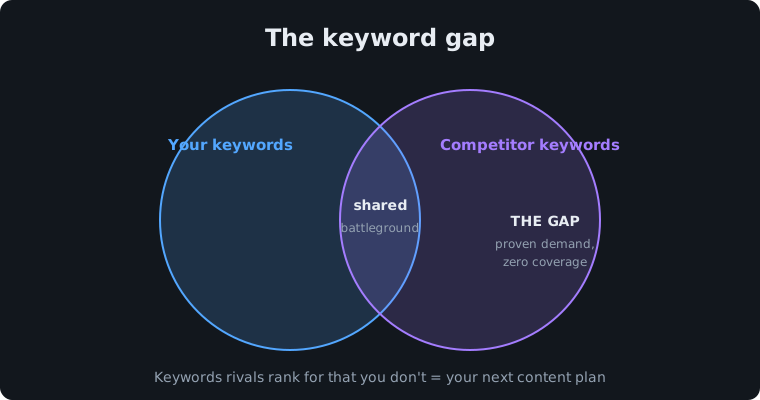
- Find the gaps your competitors already prove are worth having — the method is in our walkthrough of competitor keyword research.
- Score for winnability, not volume: difficulty, how weak the current results are, and what a customer from that term is worth.
What makes a keyword worth targeting?
Four things, and volume is the least important of them. A term deserves a page when it carries commercial relevance to what you sell, has a realistic difficulty for your site's authority, shows weakness in the current results, and represents someone who could actually become a customer.
Our own report makes the point better than an argument would. Running ImpressionMine's product against ImpressionMine's site produced terms like "hire seo expert" — 590 searches a month, difficulty 10, and a $72.06 cost-per-click — sitting in the same list as phrases with fifty times the volume and no commercial relevance whatsoever. Volume ranks the list; relevance decides it. Sorting by search volume is how businesses end up ranking for things that bring them nobody who buys.
Do keywords still matter for AI search?
Yes, but the unit changes. Ranking earns a position; AI search earns a citation, and engines quote passages rather than pages. That rewards content built as self-contained answers — a question as the heading, a direct answer in the first sentences, specifics attached to the claim they support. The keyword still tells you what question to answer; the structure decides whether an engine can lift your answer cleanly. What that looks like in practice is covered in our guide to AI SEO services.
The through-line for both: a keyword is a question someone asked. Everything useful in SEO follows from answering it better than the pages currently trying to — which is also why a keyword list, on its own, is not a strategy. It's the input to one. If you want the market mapped, scored, and sequenced rather than listed, that's what a strategic report does.
WRITTEN BY
ImpressionMine Team
SEO Research
Ready to mine your competitive edge?
Get MiningMORE FROM THE BLOG


