
Competitor keyword research is the practice of mining the keywords your rivals already rank for, measuring which ones you could realistically take, and building content to take them. It flips SEO from guesswork to score-settling: instead of asking "what might people search," you start from proof — a competitor is already winning traffic on the term — and ask "can we do it better?" ImpressionMine's September 2026 national probe measured "competitor keyword research" at keyword difficulty 14 with a $30 cost-per-click, and the surrounding cluster ("seo competitor analysis," "competitor website analysis") prices similarly: high commercial intent, thin competition.
How do you find the keywords your competitors rank for?
You find competitor keywords by running their domains through a ranked-keywords data source, then filtering to the terms that overlap your services. The working process:
- Identify the real competitors. Not who you think of — who actually occupies the search results for your services. Scrape the SERPs for your core terms and collect the recurring domains.
- Pull each domain's ranked keywords. Data providers (ImpressionMine uses DataForSEO's Labs dataset) list every keyword a domain ranks for, with position, volume, and estimated traffic value.
- Filter to relevance. Keep terms that match services you actually sell; discard their brand terms and irrelevant wins.
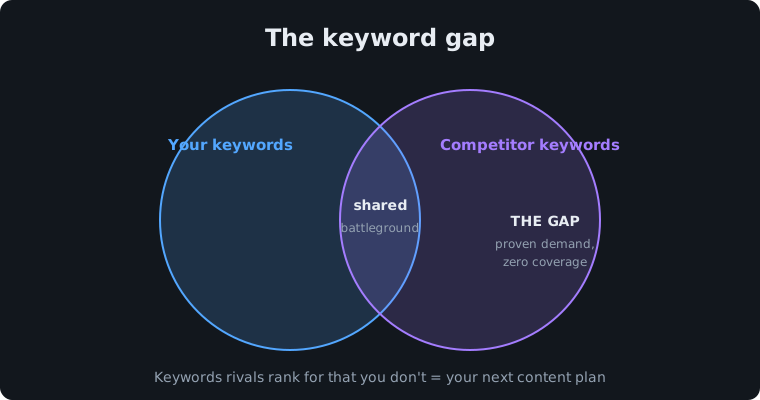
- Run the gap analysis. Keywords where multiple competitors rank and you don't are your gap list — proven demand, proven winnability, zero coverage on your side.
- Score for weakness. For each gap keyword, examine who's actually on page one. Thin content, forum posts, or outdated pages ranking well mean the door is open.
What is a keyword gap analysis?
A keyword gap analysis is the structured comparison of your ranked keywords against two or more competitors', producing the list of terms they own and you don't. It answers the only question that matters for a content budget: what should we build next? Prioritize gaps by a blend of search volume, commercial intent, difficulty, and SERP weakness — a 1,300-searches-per-month term with weak page-one results beats a 10,000-volume term locked down by national brands. That scoring is the core of what ImpressionMine's competitive intelligence reports automate: every keyword in your market scored for opportunity, with the measured SERP evidence attached.
How do you tell if a competitor's keyword is winnable?
Read the actual page-one results, not the difficulty score alone — the intent-matching principle Google Search Central emphasizes. A keyword is winnable when the ranking pages show at least one of these weaknesses: content that doesn't fully answer the query, pages more than a couple of years stale, generic national sites ranking for a local-intent search, or domains with authority you can realistically match. Difficulty scores compress all of that into one number; the number is a filter, the SERP read is the decision. In our own probe data, several $30-plus CPC commercial terms carried difficulty scores under 15 — the exact profile of a market where the incumbents are beatable.
What tools do you need for competitor keyword research?
You need three capabilities, whether they come from one platform or several: a ranked-keywords database (what competitors rank for), live SERP data (who's actually winning and how strongly), and search-volume-with-CPC data (what the win is worth). Free tools cover fragments of this; the paid suites run $100–$500 per month for self-service. The build-versus-buy line is time: assembling and scoring the data for one market takes a practitioner days per pass. ImpressionMine's approach — covered end to end in what a real SEO audit includes — runs the full pull automatically and ships it as a strategic report with the pricing published here.
How often should you re-run the analysis?
Quarterly for most local markets, monthly if you're in an active content war. Rankings churn: competitors publish, pages decay, new entrants appear. The gap list from January is stale by June. The compounding move is a standing loop — re-pull, re-score, publish against the top gaps — so every quarter your coverage widens while competitors are still guessing what to write.
WRITTEN BY
ImpressionMine Team
SEO Research
Ready to mine your competitive edge?
Get MiningMORE FROM THE BLOG


