
An SEO report example is a sample deliverable showing what a search analysis should actually contain: a dated visibility baseline, the keyword demand in your market, who outranks you and on which terms, the technical and content defects holding you back, and a sequenced plan with dates attached. A good report is readable by a non-specialist and falsifiable by a specialist. If it tells you where you rank today but not what to publish next week, it is a screenshot, not a report.
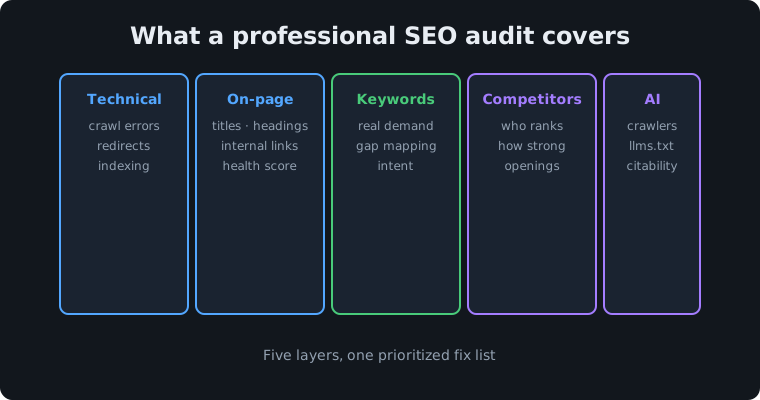
What sections does a real SEO report contain?
Four things, in this order: demand, competition, defects, sequence. Everything else is supporting evidence for one of those four.
Insist on these sections:
- Visibility baseline — one dated, repeatable score you can re-run in ninety days and compare honestly.
- Keyword demand — search volume, difficulty, cost-per-click and intent for every term, so you can sort by value instead of by ego.
- Competitor gap analysis — the exact terms rivals own that you do not, and which of their pages owns each one.
- Technical findings — crawlability, indexation, page speed, and structured data marked up against schema.org.
- Content inventory — what exists, what is thin, what cannibalizes what, what should be merged or deleted.
- Market coverage — a lane-by-market view showing which service in which city is weak.
- Link and citation profile — referring domains and what they point at, not raw link counts.
- Answer-engine visibility — whether AI assistants cite you when asked about your category.
- Publishing plan — titles, target terms, owners, dates.
- Measurement plan — what gets re-measured, when, and by whom.
ImpressionMine's own strategic report ships 12 sections, including a measured lane-by-market heat map, keyword demand, competitor gap analysis and a publishing plan.
What does a bad SEO report look like?
A bad report shows position data with no interpretation and metrics with no decision attached. The tell is simple: nothing in the document changes what you do on Monday.
| Weak section | Why it fails | Ask for this instead |
|---|---|---|
| Rankings screenshot | Positions with no cause and no next step | The ranking, the page responsible, and the fix |
| "Traffic is trending up" | Movement with no denominator and no value | Impressions by term, with intent and CPC |
| Domain authority score | A third-party guess, not a Google metric | Referring domains and what they link to |
| Fifty pages of tool export | Volume standing in for judgment | A prioritized list with effort and impact |
| No sequencing | Everything is urgent, so nothing ships | Work ordered by dependency |
Vanity metrics all share a shape. They go up without anyone deciding anything.
How should you read a report you have been handed?
Read it out of order. Start where the claims are hardest to fake.
- Go to the publishing plan first. If there are no titles and no dates, stop. The rest is decoration.
- Back up to keyword demand. A real row looks like this one from our September 2026 national probe: "seo report example" — 880 monthly searches, difficulty 15, $13.93 cost-per-click, informational intent. Cheap to rank for, expensive to buy. That single line justifies a page.
- Check the competitor section for named pages. Named URLs mean someone looked. Bar charts of "share of voice" usually mean nobody did.
- Read the technical audit findings last, and only the items the plan actually schedules.
- Verify one number yourself in Google Search Console. If it does not reconcile, ask why before you read further.
Which questions should you ask about it?
Ask the four that a template cannot answer. When was this measured, and can you re-run it on the same basis? Where did the numbers come from? What did you consider recommending and reject, and why? And the one that separates practitioners from vendors: what would make you call this plan a failure?
A report that cannot name its own failure condition is not making a prediction. It is making an impression.
Does a good report guarantee results?
No, and any report implying otherwise is selling. A report is a hypothesis with evidence attached, and the evidence should include the unflattering parts.
We ran ImpressionMine against its own site. It scored 58/100 on AI visibility and found the site had exactly one backlink from one referring domain. Fixing what it surfaced moved the score to 67. That is the honest shape of progress: measurable, partial, slow in a crowded market.
Clean domains move faster. Scissortail Fractional, a brand-new domain, reached the top ten for 11 of 11 target keywords within eight days of launch, six of them at position one, with zero ad spend. A new site in a thin market and an old site in a saturated one will not behave the same way, and a report worth what the report costs should tell you which one you are before it promises anything.
WRITTEN BY
ImpressionMine Team
SEO Research
Ready to mine your competitive edge?
Get MiningMORE FROM THE BLOG


