SEO competitor analysis is the practice of measuring who currently wins the search results you want, how strong they actually are, and where their positions are soft enough to take. It answers a question keyword research alone cannot: not "what could we target," but "what can we realistically beat, and how long will it take." ImpressionMine's September 2026 national probe measured "seo competitor analysis" at keyword difficulty 26 with a $17.00 cost-per-click — solidly commercial demand at a difficulty most established sites can clear.
What does an SEO competitor analysis include?
A complete analysis answers five questions in order, and skipping any of them produces a report that looks thorough and decides nothing:
- Who are the real competitors? Not your business rivals — the domains actually occupying page one for your services. These are frequently different, and the difference is the point.
- What do they rank for? Every keyword each domain holds a position on, with volume and estimated traffic value.
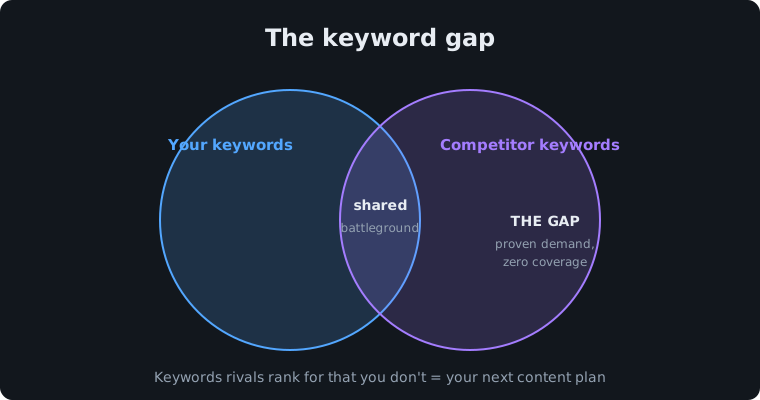
- Where are the gaps? Terms multiple competitors rank for and you don't: proven demand with zero coverage on your side.
- How strong is each position? Page authority, content depth, freshness, and whether the ranking page genuinely answers the query.
- What's the sequence? Which gaps to attack first, based on winnability rather than volume.
How do you identify your real search competitors?
Scrape the results for your core terms and count which domains keep appearing. A domain that ranks for three of your five money keywords is a search competitor whether or not you'd have named it. This routinely surfaces national aggregators, directories, and publishers sitting on local commercial queries — sites you cannot out-brand but can frequently out-specify, because a national page about a service is thinner than a local page about the same service.
The distinction matters because it changes the strategy. Beating a rival business means being better on the same ground. Beating a directory means being more specific than a page that was never written for your market in particular.
How do you tell whether a competitor's ranking is beatable?
Read the actual page, not just the difficulty score. A position is soft when the ranking page shows any of these:
- It answers a narrower or different question than the searcher asked.
- It's stale — pricing, dates, or practices that have moved on.
- It's a national page ranking for local intent, with no genuine local substance.
- Its authority is matchable — a domain in your range rather than a household name.
Difficulty scores compress all of that into one number, which makes them a good filter and a poor decision. Our own probe data shows why: the same September run measured commercial terms carrying $30–$70 cost-per-click at difficulties between 9 and 26 — real money sitting behind beatable positions, invisible if you sort by volume alone. The full scoring method is in our guide to competitor keyword research.
What tools do you need to run one?
Three capabilities, from one platform or several: a ranked-keywords database (what competitors rank for), live SERP data (who holds which position right now), and volume with cost-per-click (what winning is worth). ImpressionMine's reports run on DataForSEO for all three. Self-service suites covering this ground generally run $100–$500 per month; the categories and when to skip them are broken down in our review of local SEO tools.
The build-versus-buy line is time, not capability. Assembling and scoring one market by hand takes a practitioner days per pass, and the analysis decays — competitors publish, pages age, entrants arrive. A gap list from January is stale by June.
How often should you re-run competitor analysis?
Quarterly for most local markets; monthly if you're in an active content war with a direct rival. The value is not the one-time snapshot but the loop: re-measure, re-score, publish against the top gaps, repeat. Each pass widens your coverage while competitors are still guessing what to write next.
One caution worth stating plainly: competitor analysis tells you what is winnable, not what is worth winning. A term can be easy and still be irrelevant to your business — our own report surfaced high-volume phrases that shared nothing but a common word with what we sell. Filter for commercial relevance first, winnability second, and volume last. That order is what separates a content plan from a list of keywords. If you'd rather have that analysis run for you and delivered as a sequenced plan, see how ImpressionMine prices it.
WRITTEN BY
ImpressionMine Team
SEO Research
Ready to mine your competitive edge?
Get MiningMORE FROM THE BLOG


