Keyword search matches strings; semantic search matches meaning. A keyword engine looks for documents containing the literal characters you typed and ranks them on how those terms are distributed. A semantic engine converts your query into a numeric representation of its intent and retrieves content whose meaning sits close by, even when the wording shares nothing. Real systems run both: lexical matching for precision on names and part numbers, semantic retrieval for everything ambiguous, conversational, or long.
What does keyword search actually do?
It retrieves documents that contain your literal terms and scores them by term frequency, document length, and how rare each term is across the corpus. The engine builds an inverted index, where every term points to the documents holding it. Your query gets tokenized, stemmed, matched. This is fast, cheap, and exact. It is also brittle. Search "truck won't start clicking noise" against a page that only says "starter motor failure symptoms" and a purely lexical engine returns nothing useful, because not one word overlaps.
What does semantic search actually do?
It retrieves by meaning: query and content are both converted into vectors, and the engine returns whatever sits nearest in that space. Nothing has to match literally. "Walk-in cooler not holding temperature" can pull a passage headed "commercial refrigeration troubleshooting" because the representation encodes the relationship between those ideas. Synonyms, paraphrases, misspellings, and spoken phrasing get handled without anyone maintaining a synonym list. The tradeoff is precision on exact strings, which is why production systems merge lexical and semantic scores and rerank the result.
How do keyword search and semantic search compare?
They differ in what gets matched, not only in how well it works. Keyword search matches tokens; semantic search matches intent.
| Dimension | Keyword search | Semantic search |
|---|---|---|
| Matches on | Literal tokens and stems | Meaning encoded as vectors |
| Handles synonyms | Only if you list them | Natively |
| Strongest on | Names, SKUs, exact quotes | Questions, paraphrase, long queries |
| Breaks when | Wording differs from the page | The query hinges on one exact string |
| Rewards content that | Contains the phrase | Explains the concept thoroughly |
Why did exact-match keyword density stop working?
Because the engine no longer needs the phrase to know what your page covers. Once retrieval runs on meaning, the twelfth repetition of a target phrase adds no signal the first mention did not already carry. Worse, forcing the string into sentences that did not want it degrades the thing the model is actually measuring: whether the passage reads as a competent explanation. Google's search documentation has said for years to write for people. That stopped being polite advice and became a description of the mechanism.
What is query fan-out, and why does covering a cluster beat repeating a phrase?
Query fan-out is when a search system decomposes one query into several related sub-questions, runs them in parallel, and assembles an answer from the merged results. Someone asking about semantic versus keyword search implicitly asks what embeddings are, whether keyword research still matters, and what to change on their own site. A page that repeats the headline phrase answers one sub-question. A page that also handles the adjacent four gets pulled in four more times. Scissortail Fractional, a site we launched on a brand-new domain, reached the top ten for 11 of 11 target keywords within eight days, six at position one, with zero ad spend. That is one case, not a law.
How should you write for AI search, where passages get cited?
The unit of citation is the passage, not the page, so every section has to stand alone. Write so a model can lift eighty words and have them make sense with no surrounding context.
- Answer the question in the first two sentences under each heading, then elaborate.
- Keep sections self-contained, with no "as mentioned above."
- Phrase headings as the questions people actually type.
- Include the specifics, names, and constraints that make a passage worth quoting.
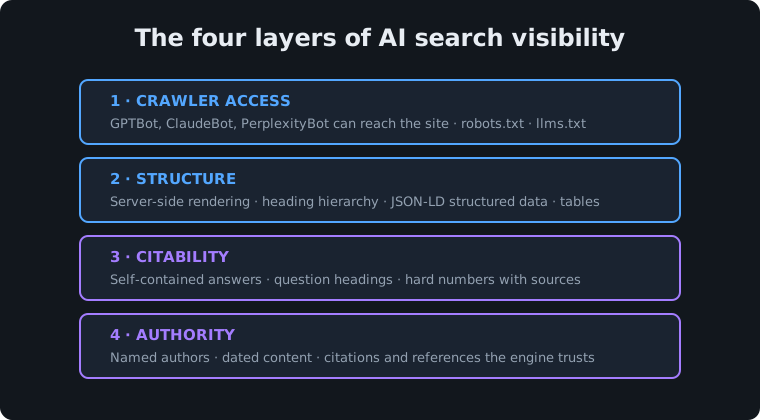
We ran our own technical SEO audit against impressionmine.com and it scored 58 out of 100 for AI visibility. Fixing what it flagged moved the score to 67. The same audit found the site had exactly one backlink from one referring domain. Retrieval-readiness and authority are separate problems, and AI SEO services that conflate them will sell you the wrong work.
Should you stop doing keyword research?
No. Keyword data still tells you what people ask for and what that attention costs. "Semantic search vs keyword search" draws roughly 210 searches a month at difficulty 7, with a $12.27 cost-per-click — cheap to earn, expensive to buy. What changes is the use. Understanding what SEO keywords are now means treating a phrase as the entry point to a topic you cover completely, not a string to sprinkle. The same goes for competitor keyword research: you are mapping which sub-questions a rival already answers, and which ones nobody has.
WRITTEN BY
ImpressionMine Team
SEO Research
Ready to mine your competitive edge?
Get MiningMORE FROM THE BLOG


