Local SEO software is worth buying when it does five jobs: samples rankings from multiple map coordinates rather than one, monitors citations for drift, runs review request and response workflows, reports in terms an owner can act on, and checks whether AI assistants can see the business at all. Most platforms do two or three of those well and pad the rest with dashboards. Before comparing any feature lists, answer one question honestly: will someone act on what the software finds every month? If not, no platform is worth its price.
What should local SEO software actually do?
Five capabilities separate working local SEO software from a reporting toy: multi-coordinate rank sampling, citation monitoring, review workflows, owner-readable reporting, and AI-visibility checking. Everything else on the feature page is packaging.
Rank sampling is the one buyers most often get wrong. Local rankings shift block to block, so a tracker that checks from a single point can report position three while a customer half a mile away sees a competitor. Insist on software that samples a grid of coordinates around each location and shows the spread, not one flattering number.
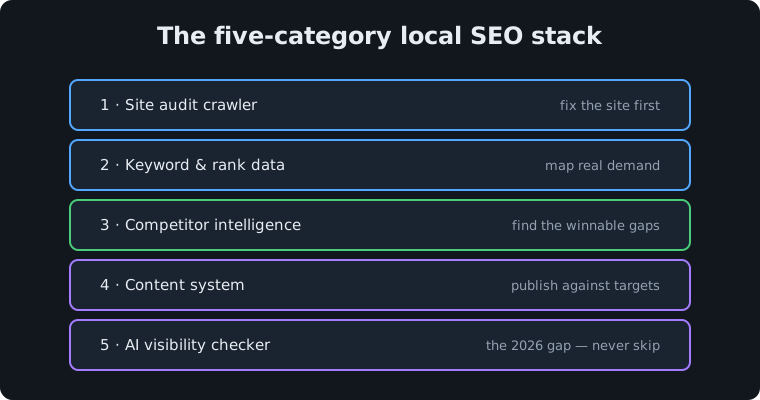
Citation monitoring matters because directory data decays: an old address or a retired phone number resurfaces and quietly contradicts your Google Business Profile. Continuous detection is the software's job; a one-time cleanup is not monitoring. Review workflows should cover requesting, tracking, and responding in one place. Reporting should answer what changed and what to do next in a page. And AI-visibility checking — whether assistants mention your business when asked for a recommendation — has moved from novelty to requirement. We have broken down the five tool categories separately.
How do local SEO software pricing models differ?
Three pricing models dominate the category: per-location, per-seat, and flat monthly. The model matters more than the sticker price, because the wrong one punishes you exactly when the tool starts working.
| Model | Scales with | Fits best | Watch for |
|---|---|---|---|
| Per-location | Locations tracked | Multi-location brands and agencies | Features gated behind higher tiers |
| Per-seat | Team logins | Teams with several active users | Paying for seats nobody uses |
| Flat monthly | Nothing visible | Single-location businesses | Hidden caps on keywords or reports |
We quote no dollar figures for third-party tools — prices change too often to print — but the model predicts your bill at the moment of growth. Open a second location on per-location billing and your cost doubles. Add a marketing hire on per-seat billing and it climbs again. Flat pricing looks safest until you read what the cap excludes. The same questions apply when choosing general SEO software, a separate decision.
Why is the local SEO software market so noisy?
Because vendors pay heavily for every buyer. Our September 2026 national probe puts "local seo software" at 390 monthly searches with a $43.59 cost-per-click and keyword difficulty 29 — a small audience that advertisers value highly. When a click costs that much, the pressure to close you shows up as inflated claims and bundled features you will never open. The moderate rating our probe gave the results page cuts the same way: comparison content ranks without much authority, so much of what you read about these tools was written to rank, not to inform. Treat the category with the skepticism its economics demand.
Should you buy software or a service?
Buy software when someone on your team has weekly hours and the skill to act on findings; buy a service when you have budget but no operator. Software finds work — a service does work. They solve different shortages.
Our own model is service-shaped: a $2,485 one-time strategic report when you have an operator and need a plan, or a $3,895/month done-for-you engagement over three months when you do not — details on our pricing page. For pace, one first-party marker: Scissortail Fractional, a brand-new domain we launched, reached the top ten for 11 of 11 target keywords within eight days, six at position one, with zero ad spend. We will not claim which technique produced that result — attribution at that speed is guesswork.
When is local SEO software the wrong purchase?
Skip the subscription when nobody will act on the findings. Software is a list generator, an unread list has no SEO value, and monthly reports nobody opens are the most common fate of this purchase.
Our own audit made the point internally. The first crawl of impressionmine.com found 7 pages, exactly one backlink from one referring domain, and an AI-visibility score of 58 out of 100. Those findings changed nothing by existing. After the actual work, the re-crawl found 13 pages and the score reached 67 — and we will not pretend any single fix moved it. The software supplied the list; people moved the number.
Two more wrong-purchase cases. A single location with a stable name, address, and phone rarely needs continuous monitoring — a periodic run of a local SEO audit tool catches what drifts. And if you are buying software to feel in motion while deferring the work, cancel now and spend the money on someone who will do it.
WRITTEN BY
ImpressionMine Team
SEO Research
Ready to mine your competitive edge?
Get MiningMORE FROM THE BLOG


