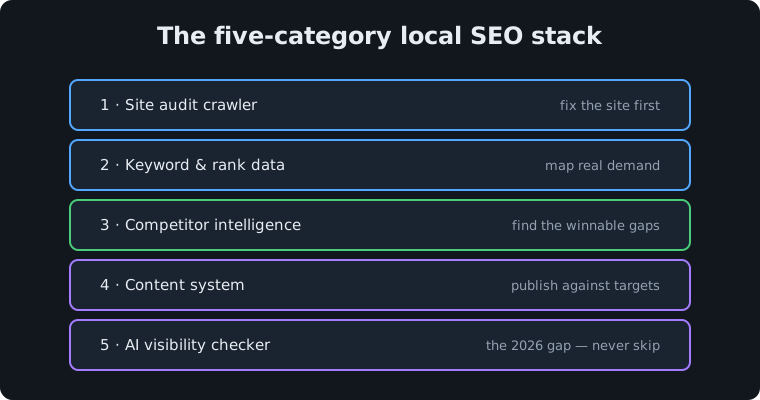
The best SEO software is whichever tool closes the gap you actually have — and most businesses buy the wrong one because they shop by feature list instead of by bottleneck. There are five categories: audit crawlers, keyword and rank data, competitor intelligence, content systems, and AI visibility checkers. You need one good option per category you're genuinely blocked on, not a suite that does all five adequately. ImpressionMine's September 2026 national probe measured "best seo software" at keyword difficulty 30 with a $32.42 cost-per-click, which tells you how crowded the buying decision is — most of what ranks for it was written by the tools being reviewed.
What are the categories of SEO software?
Every SEO tool on the market does one of five jobs. Identify which job is blocking you and you've narrowed the market from hundreds of products to a handful:
| Category | The job | Buy it when |
|---|---|---|
| Audit crawler | Finds technical and on-page faults | You've never had a full crawl, or just migrated |
| Keyword & rank data | Volume, difficulty, your positions | The site is sound and you need targets |
| Competitor intelligence | What rivals rank for, gap analysis | You need to know what's winnable |
| Content system | Plans and produces pages against targets | You have a keyword map and no output |
| AI visibility | Crawler access, structure, citability | Always, in 2026 — it's the newest gap |
How do you choose SEO software without wasting a year?
Buy in bottleneck order, and buy data before dashboards. The sequence that works: audit once and fix the findings; map real demand; publish against those targets; then add rank tracking to watch the needle move. Tools bought out of that order become login screens you pay for monthly — a rank tracker cannot help a site Google can't crawl, and a content system pointed at no keyword map just produces volume.
Two questions cut through most sales pages. What does it measure that I can't already see? and can I export everything if I leave? Measurements you can't take with you were rented, which defeats the purpose of choosing search over advertising in the first place.
What should SEO software cost?
Self-service tools commonly land somewhere in the low hundreds per month depending on seats and data volume, with enterprise platforms well beyond that. Treat any range as orientation and price the specific tools on your shortlist. Free tiers are genuinely useful for one thing — Google Search Console is free, first-party, and the only source of truth for what you actually rank for and what people clicked. Start there regardless of what else you buy.
The honest comparison is not tool-versus-tool but tool-versus-outcome. A monthly subscription still requires someone to interpret what it shows, every month. A one-time strategic report arrives already interpreted — the market mapped, the gaps scored, the sequence decided. ImpressionMine publishes both prices so the comparison is straightforward.
Which SEO software handles AI search visibility?
This is the youngest category and the thinnest. Most checkers verify only whether AI crawlers — GPTBot, ClaudeBot, PerplexityBot, Google-Extended — can reach your pages, but access is one of four layers. The others are structure (server-rendered HTML, clean headings, schema.org markup), citability (self-contained passages an engine can quote), and authority. The full stack is in our guide to AI SEO services.
We ran our own product against our own site to test this, and the result is instructive: we scored 58 out of 100, with multimodal content at 15 and an llms.txt file the checker reported as malformed — because it didn't exist, so the request was being served an HTML error page with a 200 status. Fixing what it found — writing a real llms.txt, adding genuine diagrams with alt text, correcting the page schema — moved the score to 67. The lesson isn't our number; it's that nobody had looked. Prefer tools that show you a scored breakdown by cause over ones that print a single pass or fail.
What can SEO software not do for you?
Software cannot earn links, write with judgment, or decide what your business should be known for. It measures, and measurement is necessary but never sufficient. Our own audit found the site had exactly one referring domain — no tool fixes that, because links come from doing things other people want to reference. The same applies to the decision underneath every keyword map: which searches represent customers you actually want. A tool will happily rank a high-volume term that brings you nobody who buys. Deciding that is the part you keep, and the part worth paying a person for — the four questions that separate a good hire from a bad one are in our piece on hiring an SEO expert.
WRITTEN BY
ImpressionMine Team
SEO Research
Ready to mine your competitive edge?
Get MiningMORE FROM THE BLOG


