A local SEO audit tool crawls your site and checks the things that decide whether nearby customers can find you: technical health, on-page quality, the consistency of your business details, local structured data, and — newly essential — whether AI search engines can read and cite your pages. ImpressionMine's September 2026 national probe measured "local seo audit tool" at a $51.66 cost-per-click against a keyword difficulty of just 8 out of 100, one of the widest gaps between commercial value and competition in the entire category.
What should a local SEO audit tool check?
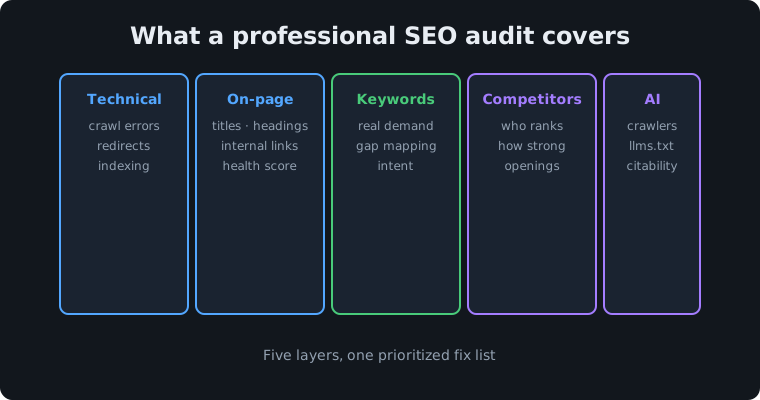
A local audit covers the five general SEO layers plus two that only matter locally. The general layers — technical crawl, on-page scoring, keyword coverage, competitive position, and AI visibility — are detailed in our breakdown of what SEO audit services include. The local additions:
- Business detail consistency. Whether your name, address, and phone number match across your site and the places that list you.
- Local structured data. Whether your pages carry machine-readable markup describing your service area, hours, and services.
A tool that only scores generic on-page factors is a general SEO tool with "local" in the marketing copy.
How is a local audit different from a regular site audit?
A regular audit asks whether your site is healthy; a local audit asks whether it is findable here. The difference shows up in three places.
First, relevance is geographic — ranking nationally for a term is worthless if you only serve one metro. Second, the competitive set is local, so a small site can genuinely beat a large one in its own market. Third, entity consistency carries weight that has no real equivalent in national SEO: a search engine deciding which business you are relies heavily on whether your details agree with themselves everywhere they appear.
Can free local SEO audit tools do the job?
Free tools are genuinely useful for detection and genuinely bad at prioritization. They will tell you that forty-seven pages have short meta descriptions. They will not tell you that forty-six of those don't matter and the forty-seventh is your highest-value service page.
Start with Google Search Console, which is free, first-party, and the only honest source for what you actually rank for and what people clicked. Beyond that, the gap between free and paid is judgment rather than data volume: paid tools mostly buy you sequencing and competitive context, which is the part that turns a list of faults into a plan.
What does a local SEO audit typically find?
The same handful of problems, in our experience auditing local sites: thin or duplicated location pages, missing local structured data, inconsistent business details, slow mobile performance, and — increasingly — no provision at all for AI search crawlers.
That last one is worth dwelling on, because we found it on our own site. Running our product against our own domain returned an AI-visibility score of 58 out of 100, with an llms.txt file reported as malformed. The truth was worse than malformed: the file did not exist, so every AI crawler requesting it received an HTML error page with a 200 status. Nobody had looked. Fixing that and the related structural gaps moved the score to 67. The details of that layer are in our guide to AI SEO services.
How often should you run a local SEO audit?
Audit fully once, fix the list, then re-audit on change rather than on a schedule. The changes that warrant a fresh audit are concrete: a redesign or platform migration, a traffic drop with no seasonal explanation, a move or added service area, or an algorithm update that visibly moved your positions.
Continuous audit dashboards mostly re-detect the same unfixed issues, which trains you to ignore them. What actually compounds is fixing the findings and then investing the attention in content and competitive work instead — the method for deciding what to build next is in our walkthrough of competitor keyword research.
One caution about tool output in general: a scored report is a hypothesis, not a verdict. Every audit tool, ours included, applies rules that are approximations of what search engines actually reward. Treat a low score as a prompt to look, confirm the problem is real on the page itself, and fix causes rather than scores. A site optimized to satisfy an audit tool and a site optimized to serve the person searching are usually the same site — but when they diverge, the person wins.
WRITTEN BY
ImpressionMine Team
SEO Research
Ready to mine your competitive edge?
Get MiningMORE FROM THE BLOG


