A local SEO checklist is an ordered list of the technical, listing, and content fixes that make a business appear in map packs, local organic results, and AI-generated answers for the areas it serves. Order matters more than contents. Crawlability and consistent business details come first, because everything after them inherits their errors. Local structured data and citations come second, content third. AI crawler access is the 2026 addition most checklists still omit.
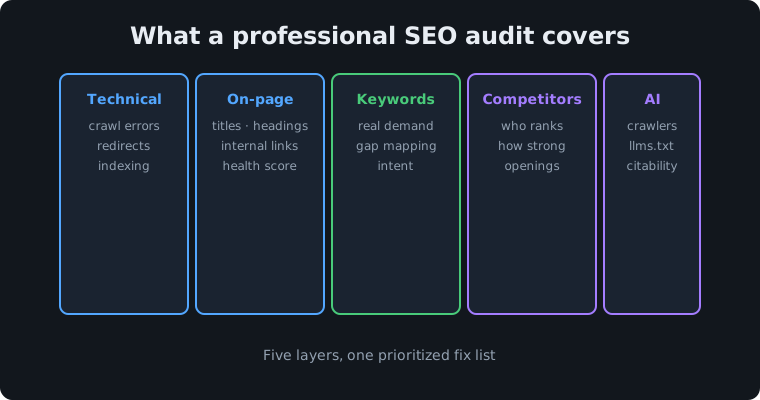
What belongs in the foundations layer, and why does it come first?
Foundations are crawlability, mobile rendering speed, and business detail consistency. They come first because a page Google cannot render cannot rank, and an address that contradicts itself poisons every citation you build later.
Work in this order:
- Confirm your money pages are indexed. Read the exclusions in the Google Search Console page indexing report, not the total.
- Render a service page as a bot would. If the phone number or service list appears only after JavaScript runs, it is broken.
- Test mobile speed on a real mid-range phone, not a lab score.
- Pick one canonical name, address, and phone number, put it in a file, and make every listing copy that file.
- Link from the homepage to every service page in plain HTML navigation.
When we ran our own audit tooling against impressionmine.com, it returned an AI-visibility score of 58/100. Fixing what it flagged moved it to 67. The same audit found the site had exactly one backlink from one referring domain. We had missed our own foundations. That is the argument for a real technical SEO audit over a checklist from memory.
Which local signals are actually worth the effort?
Three: LocalBusiness structured data, service-area pages with real substance, and a clean core citation set. The rest of the local-signals bucket is optional.
Mark up each location with schema.org LocalBusiness: name, address, phone, geo, hours, and a specific subtype if one fits. Google's structured data documentation tells you which properties it reads.
Service-area pages are where most local programs go wrong. The same 400 words with a city name swapped in is a liability; a page that names neighborhoods, cites local permitting or climate, and shows work done there is an asset. If you cannot write ten different ones, write three. Citations follow the same logic: the major aggregators plus the two or three directories your industry uses, then stop. Our local citation strategy notes cover which tiers repay the effort.
What content does a local business actually need?
Two kinds: service pages that match how people buy, and problem-phrasing pages that match how people describe a symptom before they know the name of the service.
The second kind is underbuilt almost everywhere. Homeowners search "water stain on ceiling after rain," not "roof flashing repair." Both pages should exist, and the problem page links to the service page.
Volume is the wrong filter. This article's target term, "local seo checklist," drew 210 monthly searches at difficulty 21 with a $12.07 cost-per-click in our September 2026 keyword probe. That sounds like nothing until you check what advertisers pay. Low volume plus high CPC marks a commercially serious term with weak competition, which is what competitor keyword research finds.
What changed for local SEO in 2026?
AI crawler access became a real line item. Three things now belong on the checklist.
Audit robots.txt for AI crawler blocks nobody chose deliberately; plugins and past agencies add them by default. Publish an llms.txt file pointing at your canonical service and location pages. Then structure pages so a model can quote them: a direct answer in the first two sentences, headings phrased as the questions people ask, tables where the content is a real comparison.
One data point, limits attached. Scissortail Fractional, a brand-new domain, reached the top ten for 11 of 11 target keywords within eight days of launch, six at position one, with zero ad spend. That was one site in a low-competition niche. It shows a new, well-built site can move fast in a thin market — not that any single technique works everywhere.
Where do people waste the most time?
Mostly on work that feels productive and moves nothing. Four patterns recur.
| Time sink | Why it underperforms | Do this instead |
|---|---|---|
| Minor directory submissions | Duplicate listings add noise, not signal | Fix the major aggregators, then stop |
| Weekly posts on generic topics | No local intent, no commercial intent | One problem-phrasing page per real question |
| Rewriting title tags monthly | Churn with no measurement window | Change, wait six weeks, read the data |
| Another tool subscription | Tools re-report what you already know | Fix week one's crawl errors |
How long does this take to work?
Foundations show up in days to weeks, citations in weeks, content in months. Anyone promising speed across all three is selling something.
Be honest about what you control. Indexing, rendering, and structured data are yours to fix this week. Reviews and local links depend on other people and move on their own schedule. If you would rather not run the sequence in-house, our engagement options cover a one-time strategic report and a three-month done-for-you build.
WRITTEN BY
ImpressionMine Team
SEO Research
Ready to mine your competitive edge?
Get MiningMORE FROM THE BLOG


