Local citations are online mentions of your business name, address, and phone number — in directories, industry listings, chambers of commerce, and data aggregators. They matter because search engines cross-reference those mentions to decide which business you are and whether your details are trustworthy. ImpressionMine's September 2026 national probe measured "local seo citations" at 390 monthly searches with a keyword difficulty of 22 and a $27.67 cost-per-click, with the related "local business citations" carrying a $40.98 cost-per-click — commercial interest that reflects how much money gets spent on citation services, not always wisely.
What is a local citation, exactly?
A citation is any public mention of your business details, whether or not it links to your site. They come in two useful kinds:
- Structured citations — a listing with defined fields: directories, review platforms, industry association member pages.
- Unstructured citations — a mention in running text: a news article, a blog post, a sponsor list.
Both contribute. The structured ones are easier to control; the unstructured ones are harder to earn and generally worth more, because they come with context.
Why do citations still matter for local SEO?
They matter as corroboration, not as votes. A search engine deciding whether your business is real, still operating, and located where you claim benefits from seeing the same details repeated across independent sources. Inconsistency does the reverse — three different phone numbers across three directories is evidence that at least two are wrong.
This is also why the value curve flattens fast. The first accurate listings on major platforms do real work. The three-hundredth listing on a directory nobody visits does approximately nothing, which is the uncomfortable fact underneath a lot of citation-building packages.
How many citations does a business actually need?
Enough to be consistently corroborated on the platforms that matter in your industry and region — realistically a few dozen, not hundreds. Prioritize in this order:
- Your own site, with details that match everywhere else and carry schema.org local markup.
- The major platforms your customers actually use to find businesses like yours.
- Industry-specific directories — trade associations, licensing bodies, sector platforms.
- Genuinely local sources — chamber of commerce, local business groups, community sponsorships.
Anything past that is volume for its own sake. Buying a thousand listings does not make a business a thousand times more credible; it mostly makes your details a thousand times harder to correct when you move.
What breaks citations, and how do you fix it?
The usual culprits are a move, a phone number change, a rebrand, or a franchise transfer — anything that changes the details after the listings already exist. The fix is unglamorous: audit what's out there, correct the highest-value sources first, and accept that some obscure listings will stay wrong forever.
Consistency matters more than completeness. One canonical format for your address, chosen and used everywhere, beats scattered variations across more platforms. Decide whether you are "Suite 200" or "Ste 200" and never revisit it.
Are citations still worth paying for?
Sometimes, but the cost should reflect what it is: data entry with a quality-control step, not strategy. Be specific about what you're buying. A service that submits your details to a hundred directories is selling volume. A service that audits existing mentions, fixes conflicts, and corrects the sources that actually feed other platforms is selling accuracy, which is the thing with value.
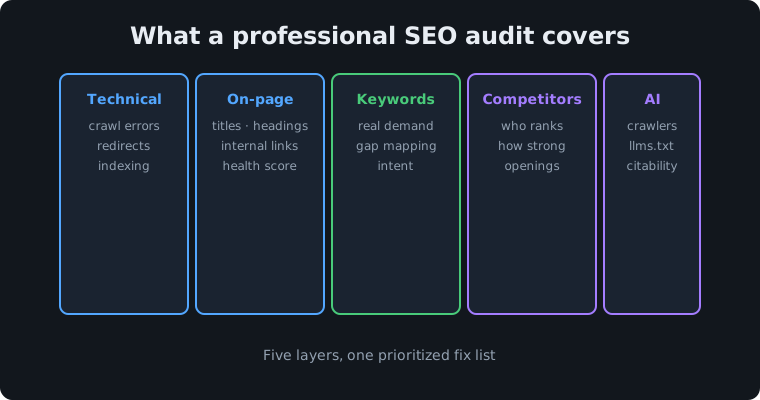
And keep citations in proportion. They are corroboration for an entity that still needs pages worth ranking — the layers that decide that are covered in our breakdown of what an SEO audit includes, and choosing what to publish against is covered in our guide to SEO keywords.
There's a newer reason to keep your details consistent, too. AI search engines assemble answers from whatever they can verify about an entity, and contradictory information is a reason to omit a business rather than cite it. The same discipline that helped traditional local rankings now decides whether an assistant mentions you at all — which is the subject of our guide to AI SEO services.
WRITTEN BY
ImpressionMine Team
SEO Research
Ready to mine your competitive edge?
Get MiningMORE FROM THE BLOG


