
A local business listing is a structured public record of your business — name, address, phone, hours, categories, photos, reviews — published on a platform someone else owns: Google Business Profile, Apple Maps, Bing Places, Yelp, and the directories specific to your industry. A small handful of listings matter enormously; the long tail of directories barely matters at all. Listings decay, so they need ongoing management rather than one-time creation. And no stack of listings, however polished, substitutes for a website you own.
What is a local business listing?
A local business listing is your company's entry in someone else's database — structured fields covering who you are, where you are, and when you are open. The platforms that publish these entries feed them to maps, voice assistants, and increasingly to AI answer engines, which prefer structured data over prose. The same facts can be declared on your own site through schema.org's LocalBusiness markup, worth doing because you control that copy at the source. A listing is not a website and not a ranking guarantee — it is a claim of existence that search engines cross-check against every other copy of your data.
Which listings actually matter?
Google Business Profile matters more than every other listing combined; a second tier of Apple Maps, Bing Places, and Yelp is worth claiming; beyond a few genuine industry directories, the long tail is close to worthless. Google's profile powers the map pack and knowledge panel where most local buying decisions start — our field-by-field Google Business Profile guide covers getting it right. Apple Maps is the default navigation for iPhone users, Bing feeds several assistant and AI surfaces, and Yelp still carries weight in dining, home services, and professional verticals. After that, ask one question of any directory: do real customers in your industry actually open it? A hundred thin listings do not add up to one strong one.
Why do listings decay instead of staying fixed?
Listings decay because platforms accept updates from people who are not you: user-suggested edits, data-aggregator feeds, algorithmic category changes, and duplicate entries. A listing is a live record on someone else's server, not a plaque you hang once. Move offices or change hours and the old data keeps circulating for months, resurfacing on platforms you corrected long ago. Every mismatch between copies is a small vote against your accuracy. The fix is a periodic audit, not heroic one-time cleanup — our local citation audit guide walks through finding and correcting the drift. Budget for maintenance the way you budget for bookkeeping: unglamorous, recurring, cheaper than the alternative.
Should you pay for a listing service?
Pay for management of the half-dozen listings that matter if you genuinely lack the time; never pay for mass submission to hundreds of directories. The economics of this niche explain the sales pressure you will meet. Our September 2026 national probe put "local business listing" at 390 monthly searches, a $36.40 cost-per-click, and keyword difficulty 4 — one of the widest value-to-difficulty gaps in our table. Advertisers pay that much per click to reach people typing a query almost nobody is competing to rank for organically. The gap exists because listing services are profitable to sell, not because listings are hard to create. Claiming a Google Business Profile is free and takes an afternoon. What earns a fee is disciplined ongoing management — monitoring edits, answering reviews, fixing drift — and any vendor who leads with directory counts instead of maintenance work is selling volume you do not need.
Can listings replace a website you own?
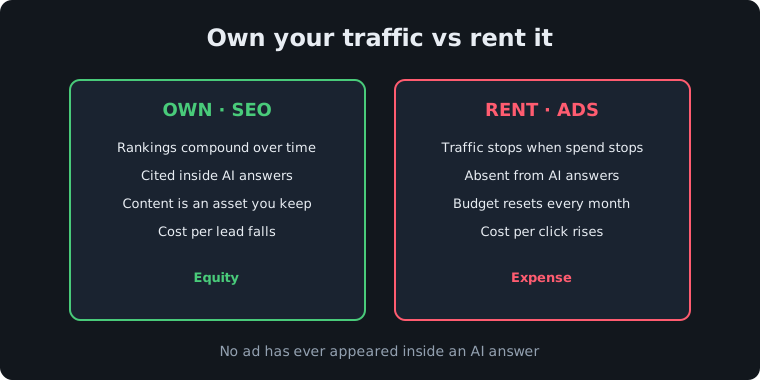
No. Listings are visibility you rent on someone else's domain: the platform sets the display rules, owns the audience relationship, sells ads against your profile, and can suspend you without appeal. Nothing you pour into a rented profile becomes an asset you keep. A site you own works the other way — content, structure, and authority accumulate as equity that compounds, rather than an expense that resets. Owned rankings can also arrive faster than the industry admits. Scissortail Fractional, a brand-new domain we launched, reached the top ten for 11 of 11 target keywords within eight days, six at position one, with zero ad spend. We will not claim which technique produced that result, but it happened on a domain the business owns, and no platform can take it back. Treat listings as distribution for a site, never as a substitute for one.
Where do listings fit in a local SEO plan?
Listings come after your own site has clean foundations and before you invest in content expansion — claim the core platforms early, then hold them in maintenance mode. Pointing five polished profiles at a broken or empty website wastes the amplification, so our local SEO checklist sequences the site work first. If you do three things this quarter: claim and complete Google Business Profile, correct your data on the second-tier platforms, and put the rest of your effort into the site you own. That is the whole listing strategy for most local businesses — smaller than the industry selling it wants you to believe.
WRITTEN BY
ImpressionMine Team
SEO Research
Ready to mine your competitive edge?
Get MiningMORE FROM THE BLOG


