Home services SEO is the practice of getting a plumbing, HVAC, roofing, electrical, or remodeling business found by people searching for that work in the specific towns it serves. It differs from general SEO in one decisive way: the buyer has an urgent problem and a narrow geography, so the winner is usually the business with the most credible local coverage rather than the biggest brand. ImpressionMine's September 2026 national probe measured "home services seo" at 1,000 monthly searches with a keyword difficulty of 14 and a $25.49 cost-per-click — meaningful demand at a difficulty most contractor sites can realistically clear.
What makes home services SEO different?
Three things change the playbook: urgency, geography, and trust. Someone with water coming through a ceiling is not comparison-shopping for a week — they search, scan the first few results, and call. That compresses the funnel and puts enormous weight on appearing at all.
Geography narrows the competition to businesses serving the same towns, which is why a small contractor can outrank a national aggregator locally. And trust signals carry more weight than in most industries, because the searcher is deciding who to let into their home.
Which keywords should a home services business target?
Target service-plus-place combinations first, emergency modifiers second, and general education last. The pattern that works:
- Service + city — the core money terms, one page per meaningful combination.
- Emergency and urgency modifiers — "emergency," "same day," "24 hour." Small volume, enormous intent.
- Problem phrasings — what the customer calls the symptom, which is rarely the trade term. People search "water heater making noise," not "anode rod failure."
- Comparison and cost terms — "repair or replace," "cost to." These capture the research phase before the call.
Resist the temptation to sort by volume. Our own report surfaced high-volume terms with no commercial relevance at all, sitting in the same ranked list as the ones worth having — the four tests for whether a keyword deserves a page are in our guide to what SEO keywords are.
How many location pages should you build?
Build one page per town you genuinely serve and can write substantively about — not one per town within driving distance. This is where most home services SEO goes wrong. A page whose only local content is the town name swapped into otherwise identical copy is a doorway page, and search engines have been demoting that pattern for years.
A location page earns its place when it carries real local substance: neighborhoods you actually work in, permit or code details specific to that municipality, jobs you have completed there, and response times you can honestly commit to. If you cannot write three genuinely local paragraphs about a town, that town does not get a page yet.
What technical issues hurt home services sites most?
Speed on mobile, inconsistent business details, and missing local structured data — usually in that order. Most home services traffic is mobile and frequently urgent, so a slow page loses the call before it renders.
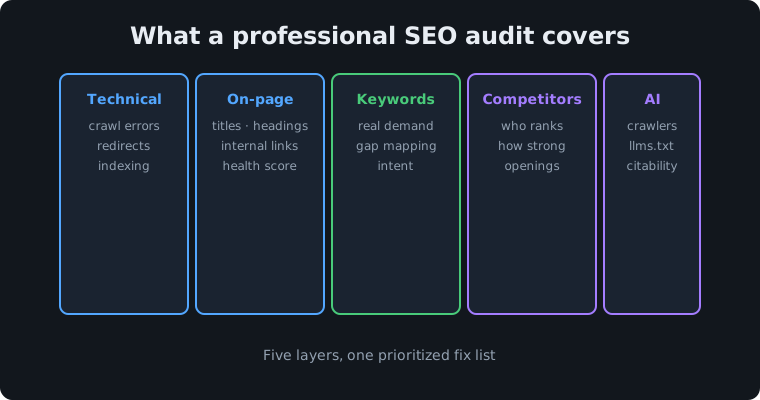
Inconsistent name, address, and phone details across your site and listings undermine the entity signals search engines use to decide which business you are. And local structured data — the schema.org markup describing your service area, hours, and services — is still missing from most contractor sites we audit. The full checklist is in our breakdown of what an SEO audit covers.
How long does home services SEO take to work?
Expect movement on low-competition local terms within weeks and on competitive service-plus-city terms within months. The variable that matters most is how contested your specific towns are, which you can measure rather than guess — the method is in our walkthrough of SEO competitor analysis.
One benchmark from our own published work: Scissortail Fractional, a brand-new domain, reached the top ten for eleven of eleven target keywords within eight days of launch — six of them at position one, with no ad spend. That is a favorable case — a clean build in a market with beatable incumbents — but it illustrates the actual lever. Speed came from picking winnable terms and building genuinely useful pages against them, not from volume or from waiting.
The compounding argument matters more for home services than most industries, because the alternative is lead-generation platforms that charge per call and resell the same customer to three competitors. Rankings you earn keep producing calls after you stop paying. Leads you rent stop the moment the invoice does — and you never owned the relationship in the first place. If you want the map of which terms and towns are winnable before committing to the work, that is what a strategic report delivers.
WRITTEN BY
ImpressionMine Team
SEO Research
Ready to mine your competitive edge?
Get MiningMORE FROM THE BLOG


