
To find competitor websites, search Google for the terms that actually bring you revenue, record every domain in the top results, and count which domains keep appearing. The domains that recur across most of your money terms are your search competitors — and they are rarely the businesses you would name as rivals. Directories, aggregators, and publishers usually hold more of your result-page real estate than the shop across town does. Identify these domains first; analyzing what they do comes second, and it only pays off if the list is right.
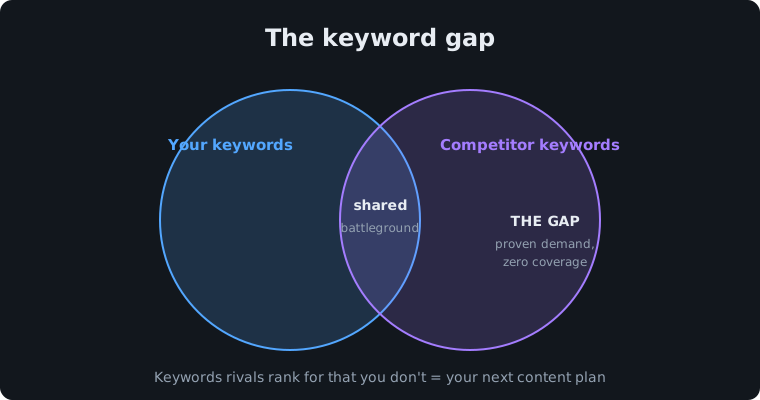
Why are search competitors different from business rivals?
Because Google ranks pages, not businesses. Your business rivals compete with you for customers; your search competitors compete with you for positions, and the two lists usually overlap by only a handful of names.
Commercial local results are crowded with sites that will never bid on your jobs: directories selling listings, lead-gen aggregators reselling your own inquiries, and national publishers running "best plumber in Tulsa" listicles. A plumber's real ranking opponents are often two local firms, three directories, and a magazine. Query intent doesn't protect you either — "find competitor websites" is classed as informational, draws 590 searches a month, and still carries a $20.03 cost-per-click, which tells you who else wants that click.
Build a strategy against your business rivals alone and you will spend months out-optimizing companies that were never holding the positions you wanted.
How do you find your search competitors?
Scrape the results for your core terms, count recurring domains, and weight each domain by how many of your money terms it holds. The whole method:
- List 20–50 money terms. Services, service-plus-city variants, and the commercial phrases buyers use. Pull real queries from Google Search Console and expand the list with competitor keyword research.
- Collect the top ten for every term. Domain and position, into a spreadsheet.
- Count recurrences. Sort domains by how many of your terms each one appears for.
- Weight by money terms held. A domain ranking for 30 of your 40 terms matters more than one ranking for 3, and a domain sitting at positions 1–3 matters more than one scraping the bottom of page one.
- Shortlist and classify. Keep every domain above your cutoff — a quarter of your terms is a workable line — including the ones that "aren't real competitors." They hold your positions; they are real.
Should you use free methods or a paid data tool?
Manual collection works fine up to roughly 50 terms; past that, pull the results programmatically. The method is identical either way — only the collection step changes.
Free: run each search in a private window with location set to your market, and record the results by hand. Slow, but it forces you to actually read your own results pages, which most owners have never done. Paid: a SERP API such as DataForSEO returns ranked results in bulk, and many local SEO tools compute domain-overlap reports for you. The tool advantage isn't accuracy — it's that you can re-run the exact same pull next quarter and diff it.
How do you tell direct competitors from content competitors and marketplaces?
Classify each recurring domain by what it sells: your service, attention, or listings. Each type takes a different beat-strategy, and mixing them up wastes budget.
| Type | What it is | How you beat it |
|---|---|---|
| Direct competitor | Sells your service in your market | Outbuild their service and location pages; win the links and citations they lack |
| Content competitor | Publisher monetizing attention with guides and listicles | Match the query's intent with deeper, more specific pages — or get featured in their roundups instead of fighting them |
| Marketplace / directory | Aggregates many providers under one strong domain | Don't contest the head term; optimize your listing inside it and target the longer, specific queries it covers thinly |
Marketplaces deserve the bluntest note: sitewide authority means you will rarely knock one off a head term, and pretending otherwise burns quarters. Take the listing, take the long tail.
When should you re-run competitor discovery?
Quarterly — and immediately after you add a service, enter a new city, or see ranking movement your current list can't explain. Results pages churn: aggregators enter markets, publishers pivot, Google reshuffles which result types show for a query.
If you scripted the collection step, re-running costs minutes. And positions really do move fast enough to justify it: when ImpressionMine launched Scissortail Fractional on a brand-new domain, the site reached the top ten for 11 of 11 target keywords within eight days, six of them at position one, with zero ad spend.
Discovery tells you who holds your positions. What each of those domains is doing — and what to copy, counter, or ignore — is the next step: a full SEO competitor analysis. If you would rather hand the whole thing off, ImpressionMine's one-time strategic report is $2,485 and the three-month done-for-you engagement runs $3,895/month — both are on the pricing page.
WRITTEN BY
ImpressionMine Team
SEO Research
Ready to mine your competitive edge?
Get MiningMORE FROM THE BLOG


